Categories
Dining NYC Uncategorized

Marathi Greek Bistro: Bringing Flavors from the Isle of Crete to Tribeca

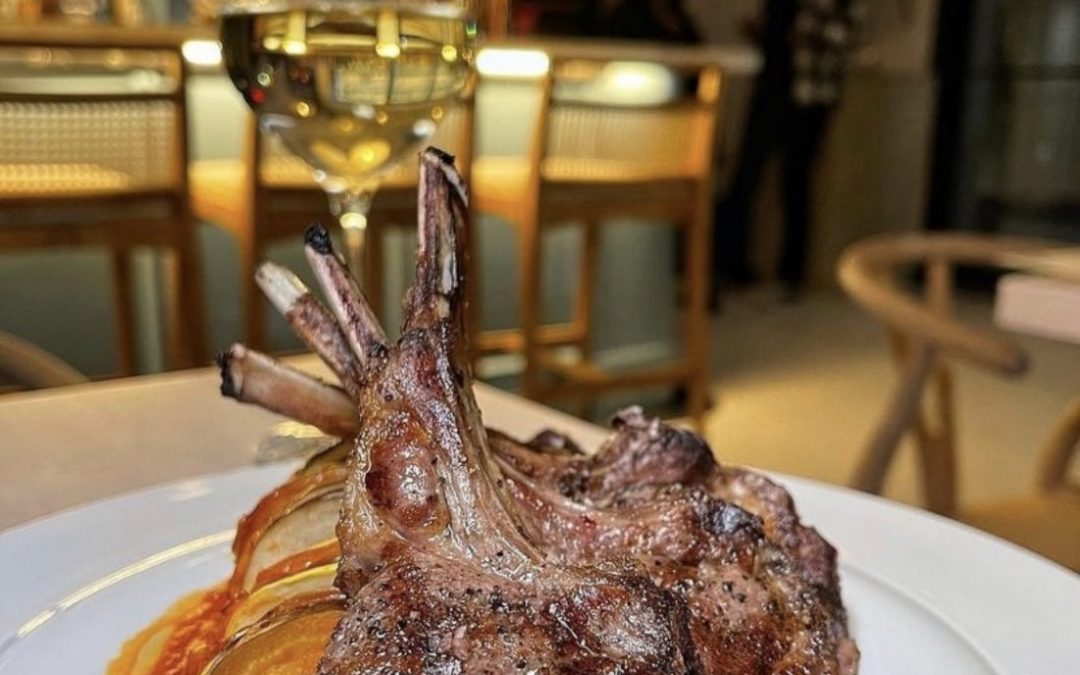
Marathi Lamp Chops. Photo: Instagram

Marathi is a cozy Greek bistro that serves up the delicious tastes from the shores of the Isle of Crete, to the heart of Tribeca! 

Your mind will undergo an immediate regional reset as the sleek, yet comfortable, surroundings will make your head swoon with the aromas and tastes of fine Mediterranean cuisine.  

Spring is here! Stop by Marathi’s striking bar after work, for a cocktail.

The restaurant — new to the neighborhood since opening its doors in November — is informed by the memories of owner Andreas Koutoudakis’ roots in his Hellenic homeland and the unparalleled ability of Chef Nicholas Poulmentis’ innovative and creative ability to provide the finest array of dishes the culture. 

Entering the three-level eatery at the corner of Duane and Church streets, you’re immediately struck by the warmth of the room and the staff. 

The full-service environment is reinforced by the breadth of a menu packed with a wide-array of Greek offerings served up with Chef Nicholas’ unique flourishes, that provide a unique tasting experience that is both familiar and exciting in its individuality. 

Marathi offers breakfast, lunch, and dinner, with both traditional and uniquely Mediterranean meals for each. 

Our visit was for dinner, when the restaurant takes on the feel of a truly high-end New York experience that is uniquely satisfying to all the senses. 

The full complement of appetizers ranging from the expectedly delicious Tzatziki to a siracha and yogurt enhanced calamari are all stunning — and the spicy tempura Shrimp Loukoumades — is a sensory and explosive standout!

The entrees are superior with a Squid Ink Fettucine boasting uniquely seasoned pan-seared scallops with saffron emulsion, providing a distinctive windfall of flavor you won’t find anywhere else. 

The grilled lamb chops with Briam — a stunning array of roasted vegetables Greek — provide a simple, but unparalleled flavor unmatched by the top steak houses in the city. 

Marathi offers a mouth-watering suite of cocktails and Greek wines. Photo: Instagram

Combined with a mouth-watering suite of cocktails and Greek wines, any visitor’s experience will be a vacation your taste buds will want to take again — and again!

Marathi is located at 200 Church Street. For reservations, visit marathinyc.com

Categories
Education Featured NYC

A LINE IN THE SAND


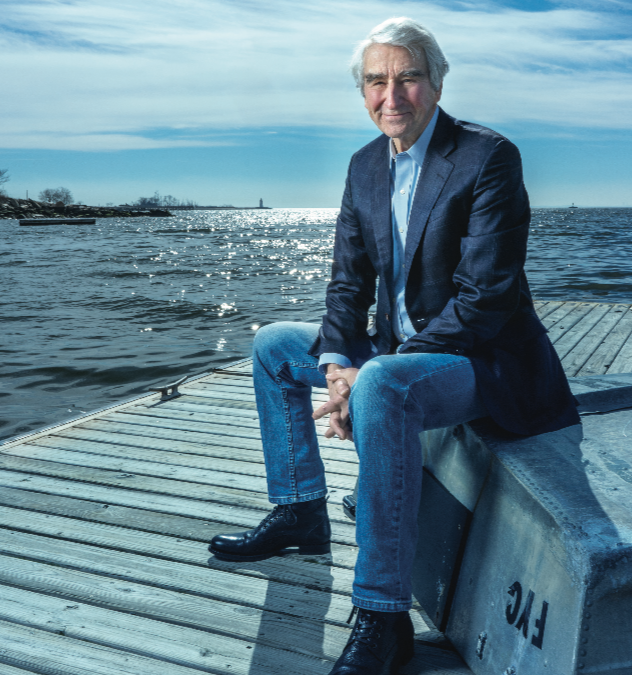
Sam Waterston is taking a stand in support of the world’s oceans.

by Mike Hammer photography by Andrew Matusik

AS A CHILD, SAM WATERSTON FELL IN LOVE with the New England coastline where he was reared. “I was a child in the days just after World War II,” he recalls. “Because of the war, fishing had been cut back significantly, and the oceans were plentiful. Growing up in Rhode Island, seafood was plentiful, full of variety, and inexpensive. Everyone believed the sea was inexhaustible until suddenly it wasn’t — and I knew I had to do something about it.”

The 80-year-old Law & Order icon has now resolved to use his enormous equity as one of America’s most respected actors to help restore the world’s waterways to the pristine and plentiful status he remembers from his youth.

He dove into the business of researching how much damage had been done — and even more importantly — what he could do to help stem the tide, and he was deeply shaken by what he discovered. On the advice of a good friend and fellow actor, Ted Danson, Sam looked into Oceana, a nonprofit organization dedicated to restoring the world’s oceans and waterways, that also boasted a long resume of environmental victories.


A Line in the Sand
Sam Waterston by Andrew Matusik


Recent triumphs have included helping to secure the banning of industrial activity in protected Canadian waters, ramping up digital monitoring of previously unregulated salmon fishing in Chile, and creating the world’s second-largest marine national park off Spain’s Mediterranean coast. “I saw that Oceana is an organization that gets things done and I wanted to be a part of that,” Waterston says. “Because of public pressure organized by Oceana, the Obama administration closed the North Atlantic for oil drilling for the next decade. Because of Oceana’s efforts, people up and down the coast lobbied for this destructive activity to end, and they swayed the governors of states on the Atlantic coast to join in.” He continues, “That gave me all the motivation I needed to get on board.”


He warns that in order to save species in the ocean — and secure our own survival


Sam joined Oceana’s Board of Directors in 2008 and within two years was testifying before Congress about the urgency of reversing ocean acidification. According to Oceana’s statistics, the world’s oceans absorb about 30 million metric tons of carbon dioxide every day. “It’s changing the chemistry of seawater and killing sea life,” Waterston says with palpable sadness in his voice. “To reverse ocean acidification, the United States must reduce its carbon dioxide emissions and transition to clean, renewable forms of energy before it’s too late.”

He warns that in order to save species in the ocean — and secure our own survival — we all need to change the way we live dramatically. Recognizing his commitment, Oceana elected Waterston Chairman of the Board last year, providing him with more opportunities to turn passion into action. “I feel so fortunate to have been placed in this position,” he says. “It’s a tremendous place with incredibly committed people and a history of important victories I would be proud to add to.”


A Line in the Sand
Sam Waterston by Andrew Matusik

Waterston’s family history includes some relatives that came from England on the Mayflower


One victory he’d love to add to Oceana’s record is replenishing the once-plentiful codfish population off the shores of New England and Canada. “I’ve seen first-hand the damage fisheries have done without serious regulation,” he says with passion. “Codfish drew Europeans to the Northeast Atlantic going all the way back to when the Vikings first got to Greenland.” Waterston’s family history includes some relatives that came from England on the Mayflower, so the history of the Northeast Atlantic runs in his veins. He says, “Alexandre Dumas wrote in the 19th century that if every cod egg reached maturity, you could walk across the Atlantic on their backs.”


To further the cause, he wrote an impassioned op-ed piece to try and compel the Canadian government to fall in line with American fishing restrictions to help save the species.

In it, he wrote, “In 2019, we stood — literally and figuratively — with the federal government to celebrate the new [Fisheries] Act, which for the first time included obligations to rebuild depleted fisheries and manage them sustainably.” Unfortunately, it seems the celebration was premature. He explains, “Rather than requiring clear, measurable actions to rebuild depleted populations to healthy levels, they went out of their way to avoid setting any enforceable standards.”

“Since the U.S. introduced a strong law in 1996 to stop overfishing and require rebuilding, 47 stocks have been rebuilt, generating about 54 percent more revenue than when they were overfished. The new Fisheries Act promised a brighter future for Canada’s fisheries. It’s time now to deliver on that promise.”

“And, if people make whales extinct, we’ll have exposed something awful about ourselves.”

Waterston’s focus is also riveted on the redemption of the imperiled North Atlantic right whales—he calls them the “Leviathans of the Bible”—which are rapidly disappearing from the planet. Oceana estimates there may be just 360 individuals left.

“Whales haven’t been diminished; they are what they were, magnificent creatures, but our capacity for wonder has been shrinking,” he warns. “And, if people make whales extinct, we’ll have exposed something awful about ourselves.”

He points to collisions with ships and entanglements with fishing gear as key factors
in the depletion of the species, with new threats emerging every year: key among them the deadly non-biodegradable plastics that are dumped into the oceans by the ton, that whales often consume or get caught in with deadly results.

But Waterston believes there is hope. “We have to produce less plastic because once it’s made, it’s here for good,” he says. “The equivalent of a garbage truck full of plastic goes into the ocean every minute. It’s an issue Oceana is rightly addressing with real urgency.”

He points out that Oceana is pressuring companies to take action to reduce plastic production and offer alternatives. It is also pushing for new legislation that will reduce the use of the deadly material in coastal countries worldwide, where a staggering 35 percent of plastic waste is generated each year.

“But the oceans are being killed by throwaway plastics,”

“Our oceans sustain life that could feed a billion people a healthy seafood meal every
day, forever. But the oceans are being killed by throwaway plastics,” Waterston says. “We should not be forced to pollute the ocean every time we eat, drink, or go to the store. We need a choice —a plastic-free choice.”

Luckily Waterston and Oceana are not alone in their battle to bring back our waterways.
In New York, the food chain has rebounded because of more stringent fishing regulations, the establishment of oyster farms in New York Harbor, and the resulting cleaner water that has welcomed the returning whales.

A significant factor was legislation to protect against over-fishing of Menhaden,
a small feeder fish, which is a key source of food for the returning whales. “It’s incredibly encouraging and a key proof of concept,” Waterston says. “This is the kind of thing that we’ve been fighting for at Oceana. It shows that the right actions produce results that prove our oceans can be fully restored if the proper actions are taken.”

And while Waterston remains highly focused on these noble efforts to save our oceans, he hasn’t given up on his storied acting career, which includes star turns on screens big and small, as well as the stage. The 80-year-old actor has played presidents (Lincoln, twice!); Shakespearian princes (Prince Hal in Henry IV and Hamlet); literary figures (Nick Carraway

“I can’t wait to be acting again,”

in The Great Gatsby); and journalists (Sydney Schanberg in The Killing Fields); not to mention his longtime role as District Attorney Jack McCoy in Law & Order, the series’ second-longest-running actor. He is looking forward to shooting another season of the hit Netflix comedy Grace and Frankie, with his equally accomplished castmates, Jane Fonda, Lily Tomlin, and Martin Sheen, as soon as the pandemic allows.

“I can’t wait to be acting again,” he says. “If it weren’t for the pandemic, I would be in a production of Measure for Measure at the Public Theatre in New York right now.

Working with Fonda and company is anything but work, Waterston says, and has led the former television D.A. to one of his more unusual experiences — getting arrested on the steps of the Capitol in 2019 when the issue-oriented cast assembled to protest climate change.

“It was a new one for me,” he laughs. “But getting arrested [during a peaceful protest] is
a wonderful way to get the message through to yourself about how deep your own convictions are.” And like the oceans for which he is a staunch advocate, Sam Waterston’s convictions are so deep they appear to be bottomless.

Categories
Featured News NYC Wellness

ANSWERING THE CALL EMT

In the battle against COVID-19, the EMT is the true front line.

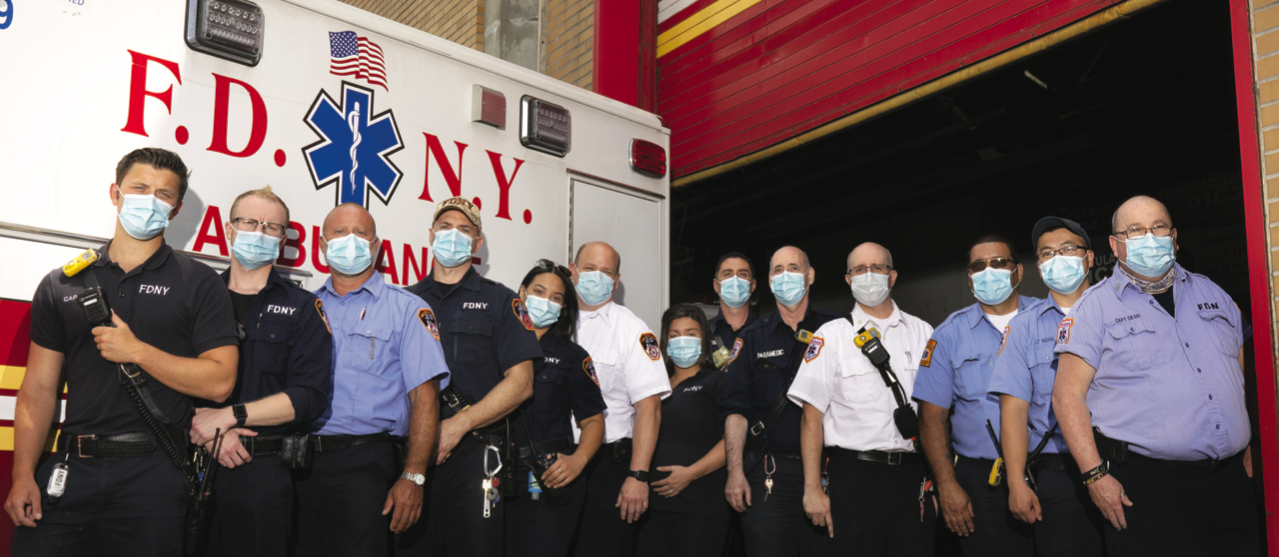
The 95 men and women who work for the FDNY’s Emergency Medical Services Division 1 at Pier 36 and South Street, are committed to the community and each other. Throughout the unprecedented challenge of the coronavirus pandemic, each and every one of them have put their lives on the line daily to serve their neighbors without wavering and they have saved countless lives because of it.

“The station has been here so long and some of our members actually live in the community,” said Deputy Chief Patrick Flynn. “When you go through something like this, you tend to see the capacity of the human spirit. You see the best of people, and that’s come through clearly both in our department and in the community.”

Flynn has been on the job for 17 years but has never seen anything like this. And he’s also never seen anyone in his command retreat in the face of the challenge of COVID-19, no matter how deadly it may be. By the end of July, New York City had more than 419,000 confirmed cases and a staggering 32,000 deaths from the dreaded virus.

Flynn, 45, has a wife and three young boys at home to worry about but he takes every precaution possible to ensure that they are safe and that he and the men and women in his command are ready to protect the people of Lower Manhattan.

Members of Flynn’s team—which he says come from “as far away as you can drive to get to work”—are overcoming their own fears every day to do battle with this invisible foe. “Everybody has their own family and we take every precaution possible to not bring the dangers of our jobs home with us,” Flynn said, explaining that he changes at the end of his shift at the station then showers and changes again before he comes in contact with his wife and three kids.

Before the virus, EMS reported an average of 4,000 calls a day throughout the city. Contrast that to a whopping 6,500 calls that were made daily at the pandemic’s peak, and you realize the level of exposure the EMTs are facing along with the toll it takes on them.

It’s a mental, physical and emotional grind,” he said. “You’re facing so much serious illness. We had to think about helping all those people and at the same time protecting our members.”

We talk to each other, share our experiences

“The station is a close-knit place,” he said. “We have therapy programs in place, but the real support comes from our peers. We talk to each other, share our experiences, and help each other through every step of the way—just as we do for the people we serve.”

Several of his own people were infected with the virus, according to Flynn. But despite the fear that came with seeing their fellow members becoming ill, those who remained took on extra hours and shifts to make sure that the community around them was covered.

“We never had to talk about coverage,”

The 60 Emergency Medical Technicians have more than 150 hours of intensive training, and the 25 paramedics—who boast more than 1,800 hours—were all outfitted with N95 masks and gloves for their protection. But the real security and strength come from each other.

“We never had to talk about coverage,” Flynn explained. “People just stepped up without a second thought.” He says, “This group continues to rise to the occasion for their brothers and sisters and the people we pledge to serve. I couldn’t be prouder of all of them.”


Categories
Featured NYC

A Time to Bond – The Finest NYPD

OVER THE PAST FIVE MONTHS

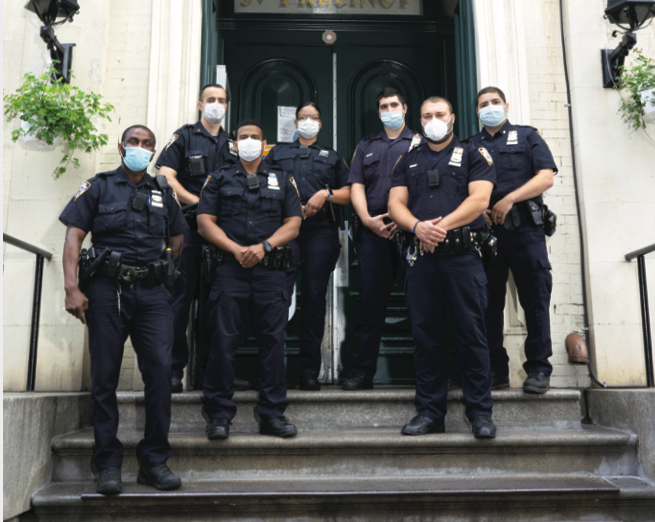
The officers who patrol Lower Manhattan not only continued to do their jobs protecting the community under dire circumstances—they deepened their bond with their neighbors. “I’ve worked in the Bronx and Manhattan South and without a doubt, this is the tightest, closest-knit community I’ve ever been a part of,” said Capt. Paul J. Zangrilli, who has commanded the precinct for just over a year.

The precinct commander said he and his officers have worked closely with local business organizations, the community board, store and restaurant owners, and Councilwoman Margaret Chin to educate them on how to best protect their properties and their health—and promote ongoing dialogue.

“In an era where there is clearly significant anti-police sentiment, in this precinct, we feel embraced and trusted,” he said. “Our officers have been made to feel that they are valued in keeping the community safe and flourishing.”

And while recent protests have led to some clashes between uniformed officers and demonstrators, Capt. Zangrilli has made it clear the men and women of the 5th Precinct are steadfast in their duty to serve and protect the protestors as well as the rest of the community.

“We can empathize with each other,” he explained. “We’ve had incredible dialogues with people who support us, and with those who are rallying for change. We know we can always improve.”

Capt. Zangrilli and his officers face down their own fears every day
to go out and patrol the community and continue to keep residents safe despite the threat of infection and possible death.

The marauding virus hit the NYPD early and hard. By May, more than 7,000 officers were reported ill and, by mid-July, 31 had died from the deadly infection.

“We had 16 confirmed cases among our ranks in this precinct alone”


A Time to Bond - The Finest NYPD
COMMUNITY SERVICE Captain Paul J. Zangrilli (center, in white shirt), with officers of the 5th Precinct and members of the Chinatown community. 5th Precinct New York- Photo by Andrew Matusik


“We had 16 confirmed cases among our ranks in this precinct alone,” Capt. Zangrilli somberly recalled. “The officers were fearful for their families. But they also knew they had to go out there and address the needs of the community more now than ever.”

Of course, precautions needed to be taken. “Patrol cars are disinfected from top to bottom with each tour,” the Captain cautioned. “Masks are worn non-stop. We sometimes hold our role calls outside and everybody was issued gloves and sanitizers. We all understood that we were the most exposed.”

Still, they continued to patrol and, in many cases, provide a new kind
of service to the community. “The pandemic brought a decrease in street crime and an uptick in burglaries,” he said. “So we educated business owners on how to best secure their properties, and we tactically deploy our officers to better respond to the evolving nature of crime in the community.”

And through it all, they continue to work with other essential service workers from Emergency Services to FDNY and other agencies to help New Yorkers survive and thrive in the worst calamity to assault the city since the terror attacks of 9/11.

“In my 15 years on the job I have never been more proud of how our officers have performed,” Capt. Zangrill said. “And we remain committed in our desire to continue to build relationships and to keep this community safe and flourishing. Our officers have done a great job and will continue to do so—despite the challenges.”

Seen in Summer 2020 Essential issue

Categories
Dining Events Featured

Brooklyn Chop House Celebrated its 1st First Year in FiDi

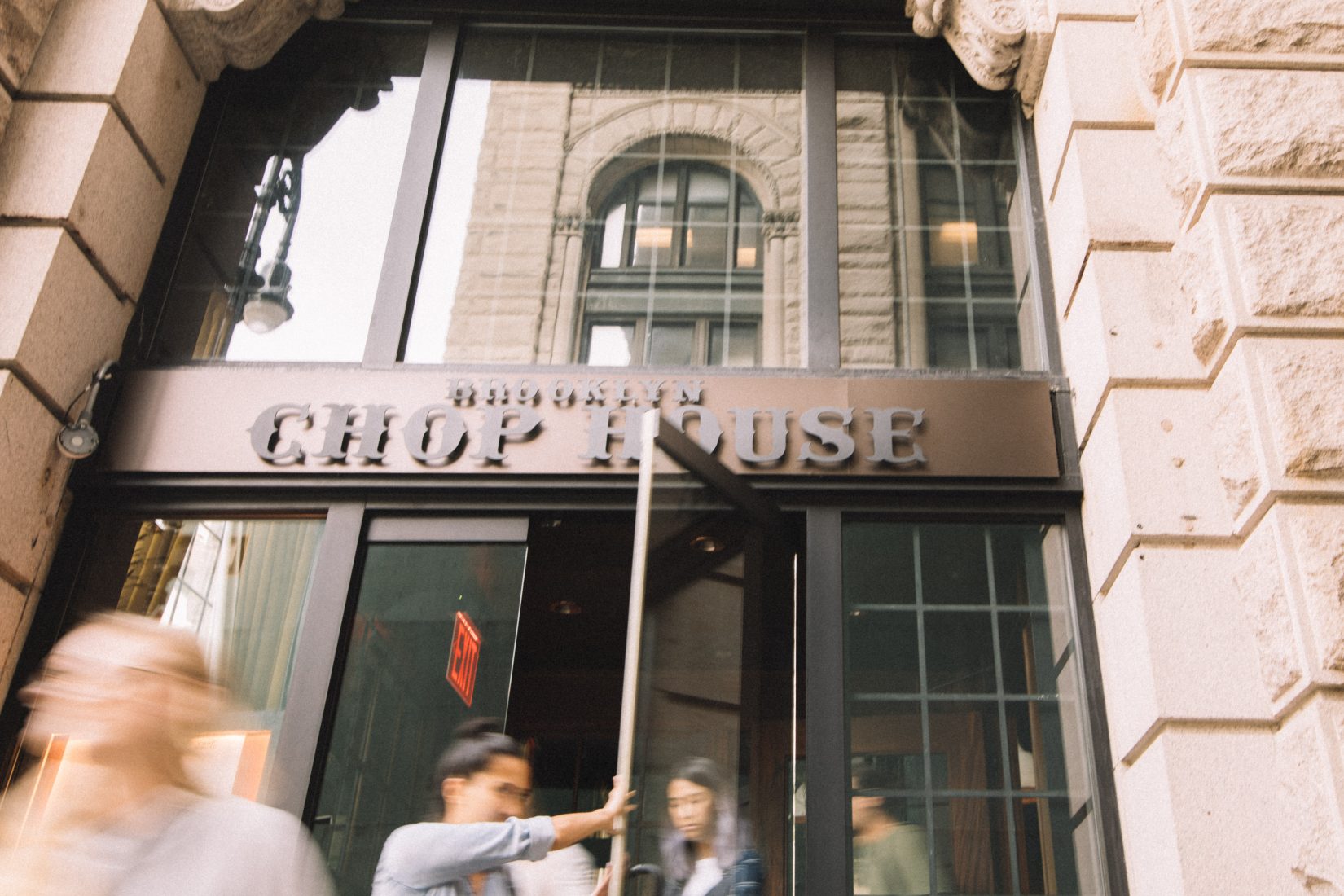
Brooklyn Chop House (150 Nassau Street) had its first birthday in the Financial District with a showcase of their signature dishes in their private dining room. 

The special dinner coincided with a fundraiser for NYC Council Member Robert E. Cornegy Jr. who is currently running for Brooklyn Borough President. 

Spike Lee was in attendance and Jamie Foxx was spotted at the downtown hotspot the night before with restaurant co-owner Robert “Don Pooh” Cummins.

“There might not be a restaurant on earth that can serve a 4-pound salt and pepper lobster, alongside a 45-day prime dry-aged Porterhouse steak and a 7 pound slow-roasted Peking Duck, but that’s what sets our restaurant apart,” said Brooklyn Chop House managing partner Stratis Morfogen.  

The restaurant’s co-starring dishes also shine bright like their vast variety of the most uniquely delicious dumplings ranging from French Onion Soup and Pastrami, to Gyro and an Impossible Plant-Based Burger Dumpling.  The meal capped off with a spiked root beer whiskey milkshake and apple wontons. 

The restaurant is open 7 days a week and serves lunch, brunch and dinner.  

For more information about the Brooklyn Chop House go to: HOME | Brooklyn Chop House

See More

NYC Experiences: Drinking and Prohibition History Tour

Clinton Hall Turns Its Tables Into Canvases for 20 Local Artists

The Meatball Shop: Flavorful Dishes, Zero Waste

Downtown’s Areppas Survival Guide

Categories
Business

TRUTH TO POWER

By Mike Hammer

Before there was #MeToo, there was Bill Phillips.

THE FOUNDER AND MANAGING partner of Downtown’s pre-eminent employment discrimination law firm, William Phillips, of Phillips & Associates, has been fighting for harassed, beleaguered, and unfairly dismissed employees for nearly a decade. “People need to know that they are not alone in terribly unfair situations,” he said. “That’s where we come in.” Phillips has dedicated himself to representing working men and women against what continue to be insurmountable circumstances. “Outside of family, there is nothing more important in a person’s life than their jobs,” says Phillips. “To lose employment is hard enough. But to be harassed or discriminated against in the workplace makes the situation exponentially worse.”

Phillips points out that these kinds of situations have been a horrific reality for far too long. He is using his skills to champion employees who have been terrified to fight back against the powerful bosses and corporations that intimidate them. “People in power have always used their leverage to overpower and silence their victims,” he said. “I decided to get in the right on the side of those people who need it. We are dedicated to helping our clients achieve the justice they deserve and restore a sense of control over their lives.”

Phillips, who has been named one of the 10 Best Labor and Employment Attorneys in New York, gave up successful pursuits in the business world to apply his experience to the defense of victims in the workplace. His unique perspective allows him to have a better understanding of the industries in which his clients and their employers work.

“I come from an investment banking background, and now I’m in the business of helping people who need it most. To do so, I’ve hired a team of attorneys.” Phillips says, “I have no reservations about surrounding myself with the best employment lawyers in the field. It’s my job to make sure our team is available to clients who need representation unique to their individual situations.”

In fact, Phillips changed the business model to allow his firm’s services to be attainable for those who feel helpless. “We don’t charge a fee to our clients unless we are successful,” he explained. “That was very rare before we opened our doors. Most firms charge upfront fees which are often unaffordable for many victims—as much as $10,000. But if we know we have a good case, we front those costs and never cut any corners on our client’s behalf.” The efforts have produced results. “We recently had a $2.3 million verdict for one of our clients against the Port Authority of New York and New Jersey in a racial discrimination/national origin case,” he said.

And while the attention gained by the more notorious cases in the #MeToo movement has shed new light on the need for firms like Phillips & Associates, he believes his work is far from done. “People need to know that resources like ours are available to them,” he said. “They may be more comfortable about coming forward now, but they still need quality representation.”

That’s why he is expanding his team to include in Westchester, Long Island, Philadelphia and even as far away as the West Coast. “Downtown is still home base,” he said. “It’s accessible to people all over the city and though we have become the largest rm in our eld, we will continue to grow as long as there is a need for our services.” He continues, “We’re here to provide quality attorneys to protect and advocate for people who are being taken advantage in the workplace environment. Discrimination and sexual harassment in the workplace continue to be devastating. As long as they exist, we will continue to fight against them and promote an atmosphere of mutual respect.” DT newyorkcitydiscriminationlawyer.com

By Mike Hammer