

Created by Phoebe Gates and Sophia Kianni, the venture-backed AI fashion shopping assistant recently launched, helping users make smarter choices. The app already has 300,000+ downloads.
In April 2025, Phoebe Gates, daughter of Bill Gates, and Sophia Kianni, who roomed with Gates at Stanford University, launched a new app, Phia. The two were so committed to building the app that they even dropped out of school to work on it full time. They chronicled their hardships on their podcast, The Burnouts with Phoebe and Sophia.
Phia, a portmanteau of “Phoebe” and “Sophia,” is a free online shopping tool designed to help shoppers find the best deals across the internet through a price comparison tool. On their April 24, 2025 episode, Sophia Kianni explained, “Phia is an app and shopping tool where you can basically find the best prices on fashion in one click. Think of it as Google Flights meets fashion, so basically while you shop, the Phia shopping tool pops up and then tells you in one click where you can find that exact same item but for a lower price, if it’s available, or it tells you if you already have the best price.”
Phia combines listings from top retail and second-hand platforms, allowing users to compare prices and shop smarter on over 40,000 sites with just one click. Phia isn’t a retailer; they earn revenue solely through affiliate links when a purchase is made, positioning themselves as a personal shopping assistant rather than a seller. Users can either download the free iOS app or add the extension to their browser and let it work its magic.
When shoppers find an item they like online, Phia users tap the “Should I Buy This?” button on the Phia browser extension to get an instant price check. It also surfaces alternatives in the resale market, helping users discover high-value and eco-conscious options. Phia tells users if the item is overpriced, low priced, or typical through a price graph that ranges from red for high price to green for low price. Then, it pulls different options from across the second-hand market. Users can sort the list by price range and whether they are looking for new or used items. They can also favorite items or build wishlists within the app, creating a helpful way to track and revisit potential buys.
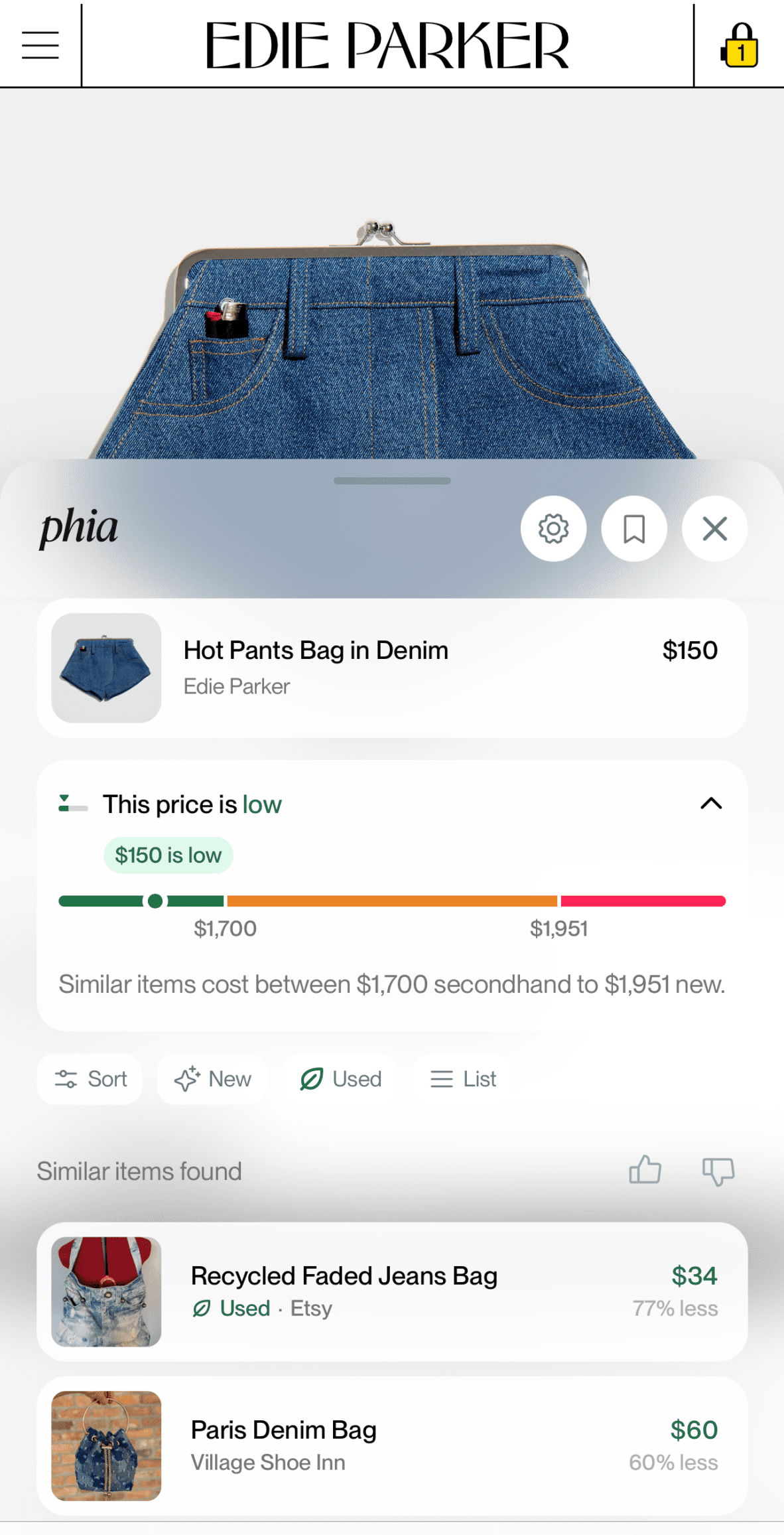
Save money by comparing prices
Consumers want to know if what they are looking at is a good purchase or if it isn’t worth it. Oftentimes, resale values and material condition are a proxy for that, which is exactly what Phia’s price graph does. It lets users know if the item they are considering is overpriced based on factors that consumers look for, such as resale value and material condition. For example, if a pair of shoes from a specific designer or store is selling for $300, Phia will either show second-hand options for a cheaper price or let users know that the comparative resale value is only around $50 cheaper. In that case, consumers may opt for the second-hand option or purchase the item new.
Eco-Savvy Cofounders with Entrepreneurial Minds
Prior to working on Phia, Gates was studying pre-med, and Kianni planned to pursue a legal career when an entrepreneurship class sparked their curiosity to create something people need. Through sharing their experiences of online shopping and the struggle of finding retailer items on second-hand sites, they created the idea for Phia.
Back in 2020, Kianni founded Climate Cardinals, a youth-led nonprofit, to translate climate change information into different languages, making it more accessible to a wider audience. She is also an advisor to the United Nations and was listed in Forbes 30 Under 30 in 2023. Gates has also publicly advocated for women’s rights and reproductive health.
They both have always valued sustainability and shopping second-hand, and realized how difficult it was to align those values with fashion. Phia empowers consumers to make the eco-conscious choice. According to the British Fashion Council, there are enough clothes to dress the next six generations, with second-hand fashion offering up to an 80% carbon reduction.
Fast fashion has been a problem for years, posing significant ethical and environmental challenges. Not only does the industry rely on exploitative labor practices, but it also fuels overconsumption by prioritizing rapid trend turnover, which results in massive textile waste. Fast fashion contributes significantly to environmental pollution through toxic dyes, water waste, and high carbon emissions. Additionally, it encourages throwaway culture by prioritizing trends over sustainability and quality.
Phia is trying to reverse these ideologies. Gates and Kianni found, while experimenting with the concept, that people want to know the quality and value of items. People would rather spend $300 on an item that will last them three years than $100 on a similar item that they have to replace halfway through the year. By showing users the longevity of items, Phia encourages shoppers to think about how long a piece will hold its value and how quickly fast fashion depreciates.
Since its launch in April, Phia has reached over 300,000 app installs, and users are praising the app for its ability to find the best prices on fashion items, especially when compared to traditional online shopping methods. When starting the app, Gates did not want to use her family to help launch the idea. They refused family funding in order to build something truly authentic. Not only did they successfully raise $850,000 in funding, but they have attracted many high-profile investors, such as Kris Jenner.
The triumphs and struggles of women founders are a central part of Phia’s narrative. In March, as part of entrepreneur Alex Cooper’s Unwell Network, Gates and Kianni debuted their podcast, The Burnouts with Phoebe and Sophia. The podcast touches on the ups and downs the duo faced as they built Phia and explores the realities of building a career in your 20s, including negotiating ambition, burnout, and the challenges of entrepreneurship. “We don’t have millions of dollars to spend on Call Her Daddy ads, but we do have ourselves,” Kianni told Forbes.
Phia stands out among other fashion apps as an innovative platform that combines style, savings, and sustainability. It wraps eco-conscious behavior into a seamless shopping experience without the guilt or friction often attached to ethical choices. For anyone who shops online, especially those eyeing designer brands or resale treasures, Phia will be a game-changer in how you discover and evaluate deals. DTM