
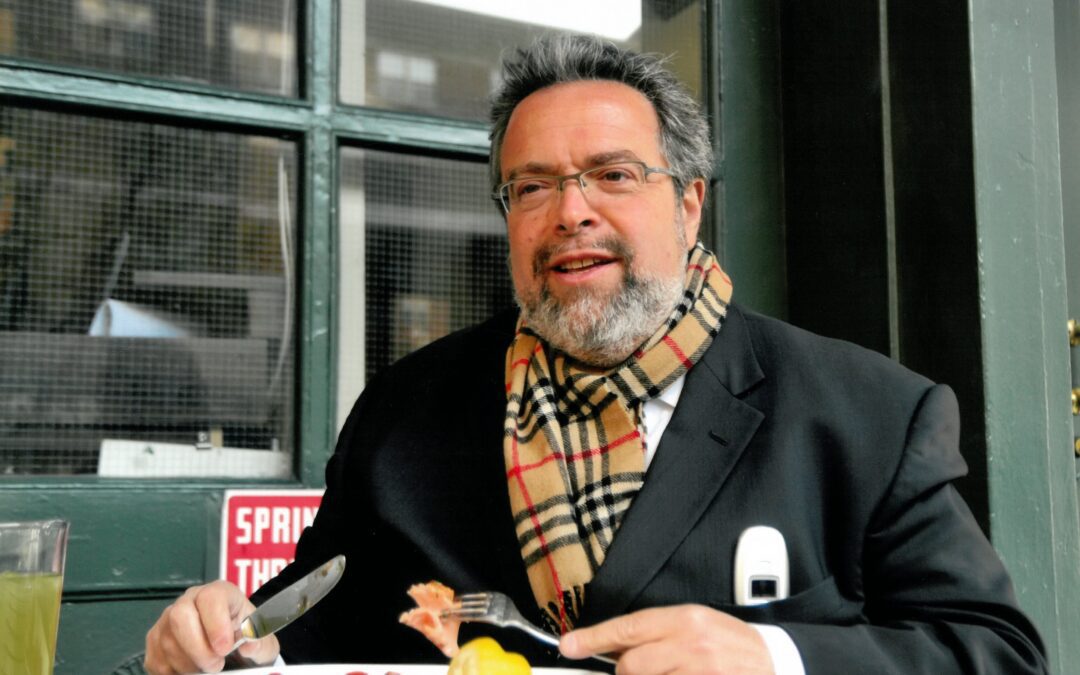
Drew Nieporent has always been more than a restaurateur. He’s a storyteller, a risk-taker, and a New Yorker to his core. For more than four decades, he has shaped the way this city eats, partnering with icons like Robert De Niro and Nobu Matsuhisa, creating spaces that became institutions, and mentoring generations of talent along the way.
But for me, Drew is also family. He was there when DOWNTOWN Magazine first launched, serving on our board from day one and gracing our third cover, a cover he told me he framed alongside Beyoncé and Leonardo DiCaprio. “That was very good company,” he laughed.
When I called him for this story, Drew answered with a chuckle. “Grace, what a blast from the past!” That instant warmth reminded me why he’s not only a titan of hospitality, but also one of the most genuine people I’ve ever known.
Drew’s story begins long before the restaurant empire. His very first appearance in front of the public wasn’t in a dining room at all, but on television in 1955, as a baby in an Ivory Snow commercial, alongside his mother, a working actress. It was a fitting debut for someone whose life would always be lived at the intersection of performance, personality, and people.
Roots, Family, and First Tastes
Born and raised in Peter Cooper Village, Drew grew up in a middle-class Jewish family that valued hard work, community, and character. His parents’ apartment felt both vibrant and confining. “It was a great place to grow up, but it was like being in a prison cell,” Drew said. “There were eight apartments on every floor. But it was great for trick-or-treating, you didn’t even have to leave the building.”
His father, Andy, worked for the New York State Liquor Authority, a role that quietly defined Drew’s destiny. Restaurateurs, grateful for his father’s help pushing their liquor licenses through the bureaucracy, invited the family to dine. “We were eating on the arm, eating for free,” Drew remembered. He collected menus, memorized dishes, and soaked in the theater of restaurants. Those meals planted the seeds of what would become a lifelong passion.
His mother, a former actress and casting director, was equally influential. Though she joked about being the “ice queen” in the kitchen, she modeled resilience and showmanship. “My mother told me, ‘Son, I don’t care what you do, even if you’re a garbage man, just do it to the best of your ability,’” Drew said. Her high standards and bigger-than-life personality stayed with him.
Drew also shared a close bond with his older brother. “We stayed in the same room growing up. He didn’t care about food, which was great, I always ate off his plate,” Drew recalled with a grin. That mix of family grounding, neighborhood toughness, and early exposure to restaurants shaped the man who would go on to redefine dining in New York.
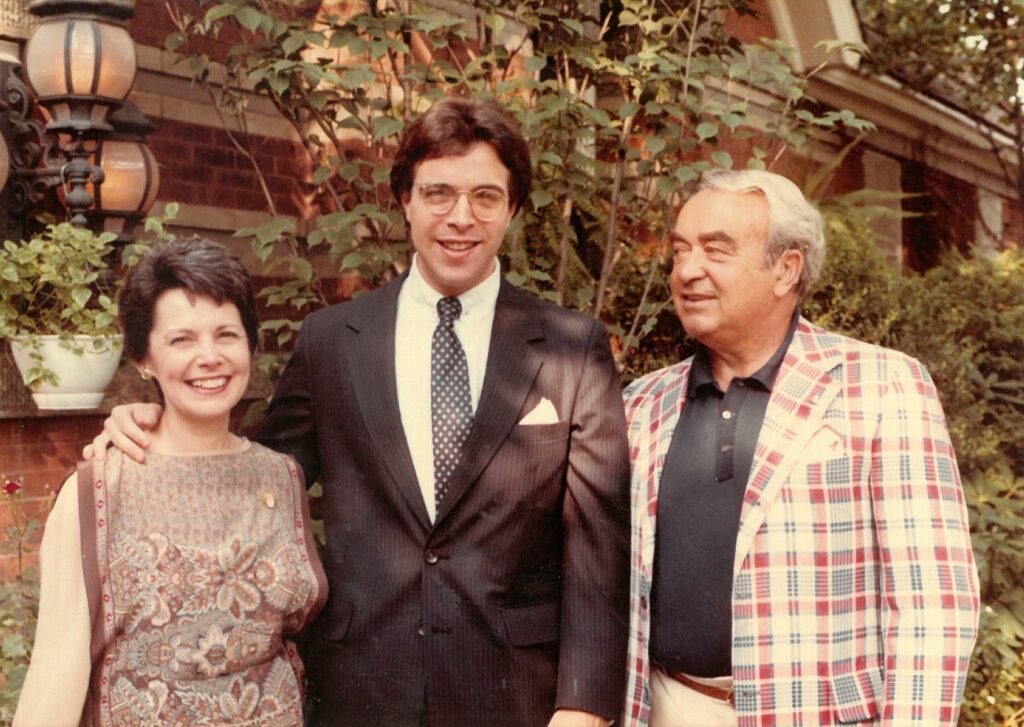
Nieporent pictured with his parents
Cornell, Cruises, and Colonel Sanders
By high school, Drew’s fascination with restaurants was undeniable. After Stuyvesant, he chased opportunities wherever he could. At just 18, he bluffed his way onto the MS Vistafjord cruise liner, claiming “very experienced in Russian service” despite never having waited tables. He got the job. Over the course of his college years, he would sail on more than a dozen cruises, working seven days a week, breakfast through dinner, and learning the rhythms of hospitality by sheer immersion.
One encounter stood out: Colonel Sanders himself checked into the small hotel run by Cornell’s Hotel School while Drew was still a freshman. Never shy, Drew knocked on the Colonel’s door to introduce himself. After their conversation, Sanders shook his hand and said, “Son, with boys like you, America’s got nothing to worry about.” It was a blessing Drew carried with him, proof that boldness could open unexpected doors.
Cornell became the true training ground. Though Drew had imagined attending the Lausanne School in Switzerland, his mother nudged him toward Cornell, and he got in. It wasn’t the cooking school he envisioned, but it gave him structure, connections, and momentum. He describes his career as an ascension, each chapter leading inevitably to the next. “Everything led to something,” Drew reflected. “It led to opening the first restaurant, getting three stars, then led to the next. I mean, it’s Robert De Niro. I know. I love it. It’s an amazing story. I think it’s a great story. I’d actually love to see it in a movie.”
Montrachet, Bouley, and the Critics
That movie-worthy moment came in 1985, when Drew opened Montrachet, a pioneering Tribeca restaurant that earned three stars from The New York Times just seven weeks in. At only 29, he described it as “like winning the lottery.”
Critics became central to his journey. “I was obsessed with reviews,” he admitted. “They could make or break you.” He recalls Mimi Sheraton walking in unannounced, scrutinizing every detail, and later, years on, asking him to speak at her funeral. “You’ll never win a battle with a food critic,” she once advised him.
Working with Chef David Bouley was another turning point. “Bouley was a remarkable talent, but sometimes creative genius collided with the pace of fine dining,” Drew reflected. He made the difficult decision to part ways, a move he later called “killing the goose that laid the golden egg.” Yet time softened the edges: “I’m glad we found peace,” he said quietly.
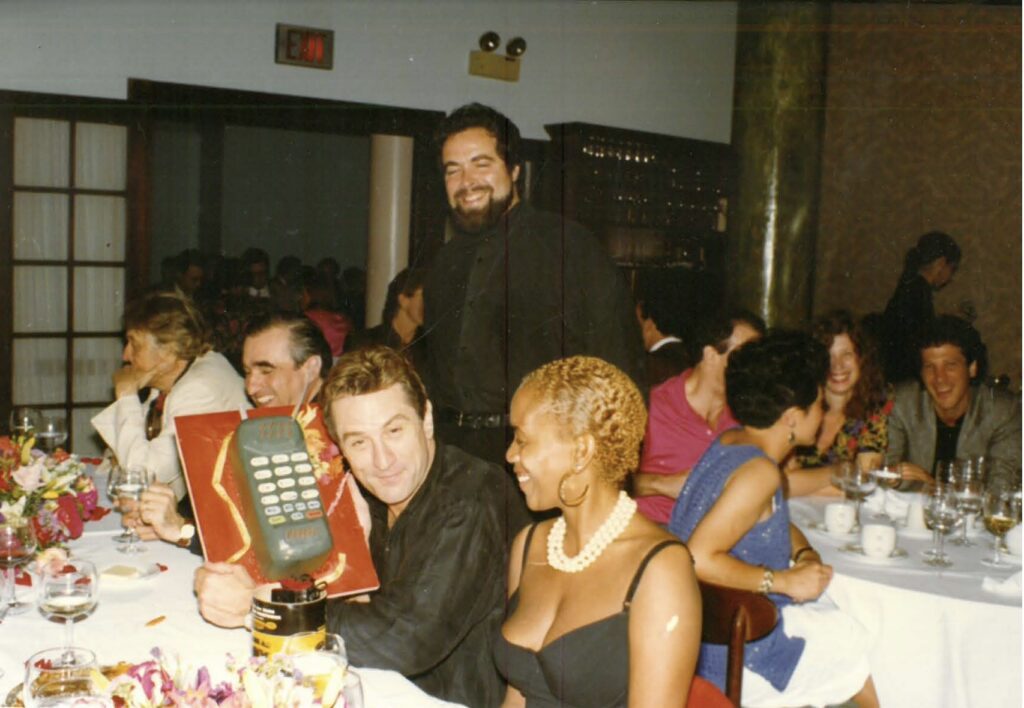
Nieporent with his friends and partner Robert De Niro with Toukie Smith, at Montrachet.
The Nobu Era
If Montrachet made Drew a star, Nobu made him a global force. Introduced to Chef Nobu Matsuhisa by Robert De Niro, Drew helped transform a 40-seat Los Angeles sushi bar into a worldwide empire.
Behind the glamour, there was grit, and politics. Drew has compared the Nobu partnership to an episode of Survivor. “There were four of us. And when it’s three against one, you’re finished.” He admits the history has been rewritten at times, but he remains proud of the empire he helped build. Today, there are more than 50 Nobu restaurants worldwide, plus hotels, a cultural brand as much as a culinary one. “Seeing Nobu grow from those early conversations into a worldwide name has been extraordinary,” Drew said.
Tribeca Grill, Downtown, and De Niro
Opened in 1990 with De Niro as a partner, Tribeca Grill became an anchor for Lower Manhattan’s rebirth. Over 35 years, it was a gathering place for stars, neighbors, and New Yorkers alike. Though the restaurant closed in 2024, Drew felt no sadness. “New York diners want the newest and the latest,” he said. “Tribeca Grill had its time, and it was monumental. You have to know when to hold and when to fold.”
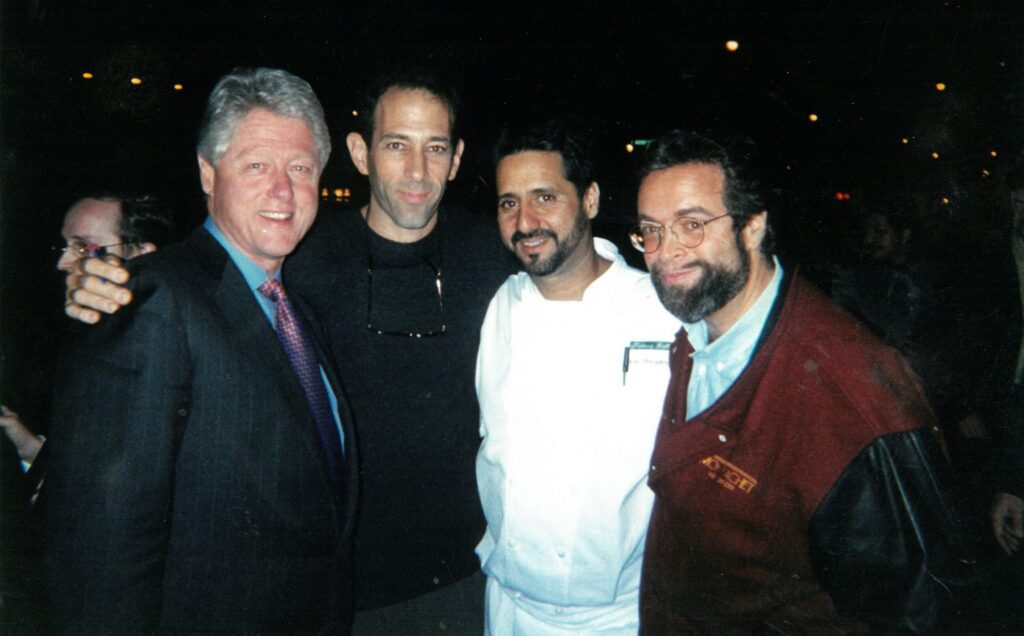
Former president Bill Clinton with team at Tribeca Grill.
Philosophy of Hospitality
For Drew, restaurants were never about exclusivity. “French menus, dress codes, barriers, I stripped all that away. My contribution was making dining accessible without losing quality,” he said. That approach inspired countless restaurateurs and cemented his place as one of the most dynamic in the industry. He’s also unflinchingly candid about the business. Of critics he says, “You’ll never win a battle with a food critic,” he repeated. On policies: he was skeptical of no-tipping models but respectful of their intentions. On politics: “Government gridlock has made it harder for restaurants and small businesses to thrive. Downtown has come back strong, but leadership needs to catch up.”
A Legend with Many Hats, Including Author
Despite the empires, Drew insists balance is a myth. “When you’re at the restaurant, your wife’s upset. When you’re at home, the restaurant’s upset. There is no balance,” he said. Yet he’s remained grounded in family, friends, and the simple joy of feeding people.
Today, Drew runs Crush Wine on 57th Street, oversees the legendary MSG hamburgers, continues to be an owner and presence at Nobu Downtown in New York’s Financial District, and dreams of opening a delicatessen, “the kind that could rival Katz’s, but with my own spin.” He also recently penned a new memoir I’m Not Trying to Be Difficult: Stories from the Restaurant Trenches, with Jamie Feldmar. (Grand Central Publishing.)
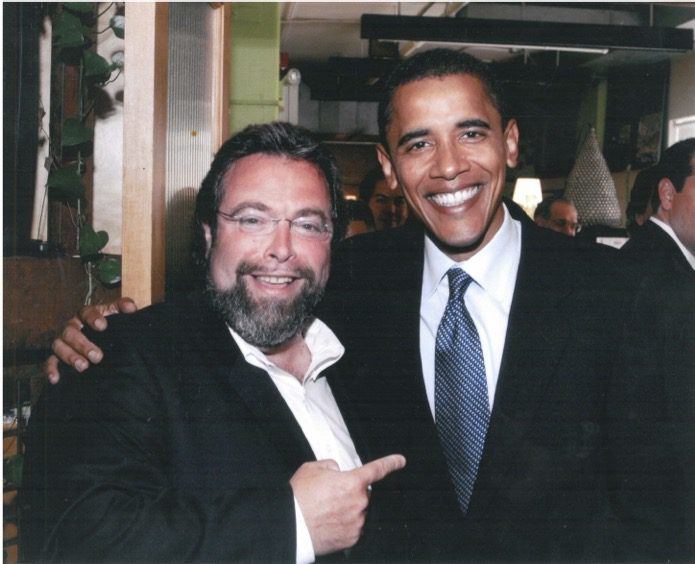
Nieporent with Former President Barrack Obama.
A Full-Circle Moment
As I listened to Drew recount his life, from free meals with his father to global empires, from framed magazine covers to Nobu partnerships, I couldn’t help but think how rare it is to sit with someone who shaped not just restaurants, but culture.
“Every time I look at that frame,” Drew said, smiling at his DOWNTOWN Magazine cover beside Beyoncé and Leo, “I feel like I’m in good company.”
And today, whether it’s at Nobu Downtown in the Financial District or here in DOWNTOWN’s Fall 2025 issue, Drew Nieporent is still exactly that- in the very best company.
And so are we. DTM
Photo courtesy of Drew Nieporent.