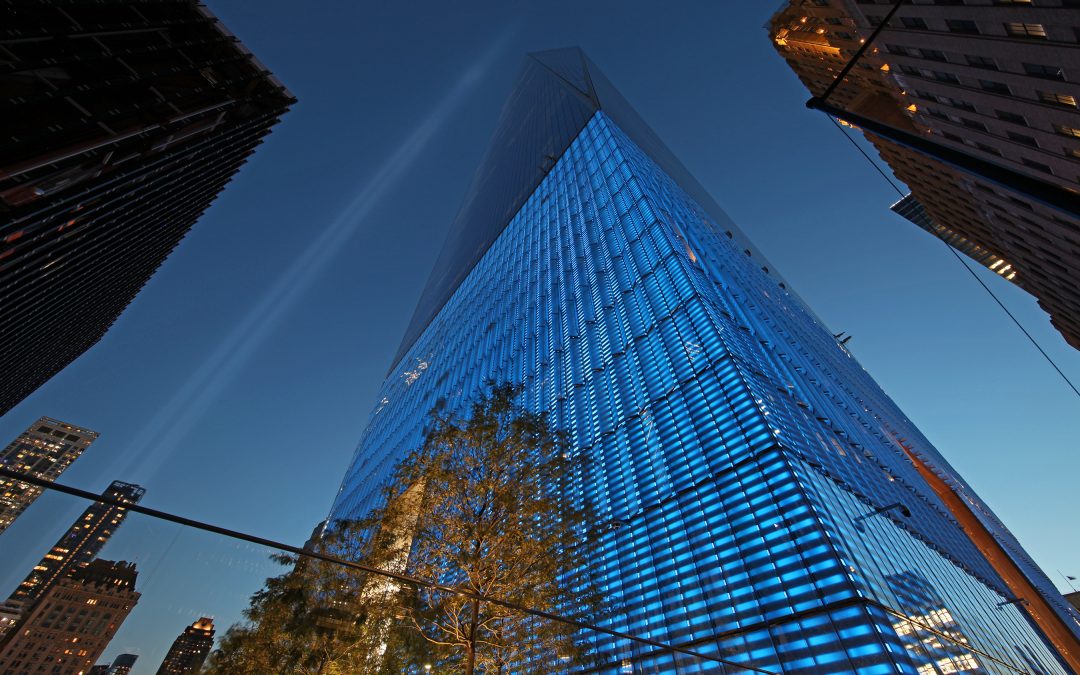
The Tribute in Light, designed by Gustavo Bonevardi. Photo by Joe Woolhead.
Twenty years later, Tribute in Light helps New York City heal. Photo by Joe Woolhead.
IN NEW YORK, art isn’t limited to the galleries and theaters; it overflows into the streets, draping itself across the city’s skyline. Architects, artists, social organizations, and New York’s many public agencies each play a hand in building the immersive installations that speak towards some of today’s most pressing topics. New York-born architect and artist Gustavo Bonevardi is recognized for his many public projects exploring the impact local and global crises have on our population, and in New York today he is perhaps best known, along with creative partner John Bennett and lighting designer Paul Marantz, as among the artists behind Tribute in Light, an annual light projection commemorating the anniversary of 9/11. Today managed by the 9/11 Memorial & Museum, Tribute in Light was conceived with the support of the Municipal Art Society as two beacons echoing the Twin Towers as they defined New York City’s skyline. Though the two light beams don’t represent the actual size of the towers, which were each an acre in size, the gap between the beams and the net acreage the installation occupies is approximate to the size of the towers. “What we’ve settled on is to create not the buildings themselves, but the void between those,” Bonevardi notes, emphasizing “this tension between these two vibrating pillars.” With the beacons of light reminiscing what the Twin Towers represented, Bonevardi adds that, “to my mind, it always seemed like the World Trade Center towers were sort of like a gateway, like a door to the city,” symbolizing open arms to the millions passing through each year. In the 20 years that Tribute in Light has taken place, it has acquired a steadfast following that looks to those lights each year, recalling that same message the towers once represented.
Tribute in Light. Photo by Joe Woolhead.
Yet, Bonevardi hopes that the installation looks less at what was, and more at what could be. The Freedom Tower now erected serves as a new vision for the city’s reception of travelers and immigrants alike. Lower Manhattan on its broader spectrum has transformed from a once “beautiful and haunting” evening ghost town, as Bonevardi describes it, to a thriving neighborhood accommodating both residential and commercial tenants collaborating together to build a culture of arts, activism, shopping, and dining.
Gustavo Bonevardi. Photo by Ann Foker.
“I think that’s what New York is, it’s always fresh and new and vibrant,” Bonevardi notes, adding that when it comes to downtown’s future, “I expect it to be something unexpected. I expect to be surprised somehow. I mean, the city is constantly reinventing itself.” His most recent proposal, Missing, explores what traces the COVID-19 pandemic left on cities through footsteps echoing the many who passed away these nearly two years. Whether through such unexpected displays of resilience or delicate works of art, Bonevardi and the many other artists across New York show that this city champions perseverance and adaptability above all, underscoring what it takes to be a New Yorker.
Designer Noha Hassan has a gift for zeroing in on the unexpected, perhaps influenced by her globe-trotting past. Hassan’s life has taken her around the world: born in Egypt, she lived in both Cairo and Brussels during her studies, and then Jeddah, Luxembourg, and finally London, before she settled in New York City. Despite her now decade-long calling in the interiors world, Hassan also spent more than eight years working in finance at firms including Goldman Sachs and JP Morgan in London among other business ventures. She regularly calls on her life experience to bring a personal element to her design, making her work unique, and uniquely hers.
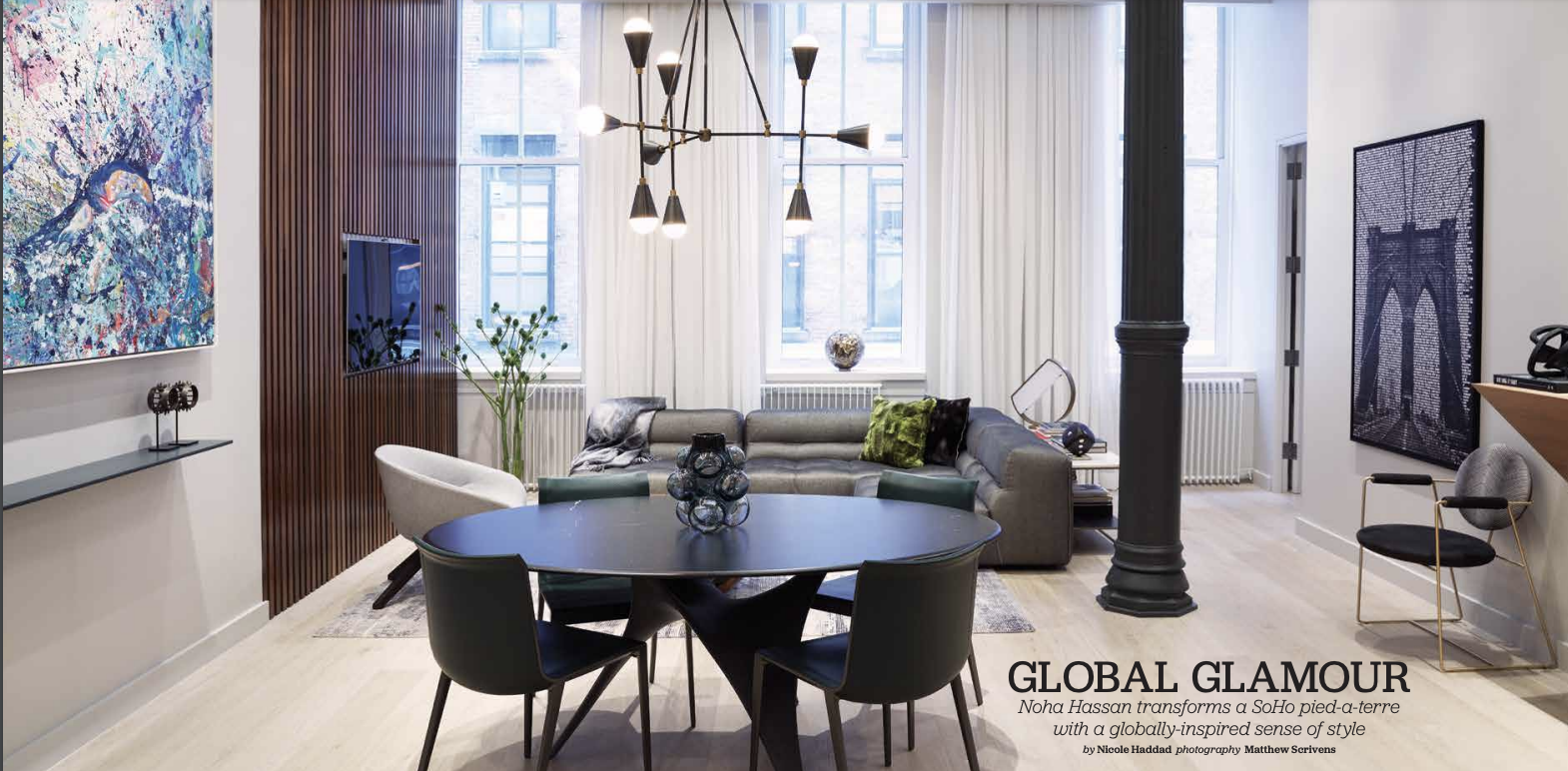
Photography by Matthew ScrivensLIGHT AND AIRY: Hassan brought in furnishings designed to enhance the expansive feeling rendered by the high ceilings, letting the linear wall slats and handsome columns draw the eye upwards.
Photography by Matthew Scrivens“Lighting should serve as functional art: architectural and industrial.”
Her worldly past is fascinating and unusual to say the least, and helps give context to her intuitive approach to interiors. Hassan’s seeming effortless touch yields a global aesthetic, and feels natural and layered. Case in point: When Hassan was tapped to renovate a 1,450 square-foot pied-a-terre in SoHo, she brought a new perspective to the project.
In a stroke of luck, the one-bedroom, plus den and open-plan living and dining area already contained distinctive cast-iron support posts original to space. “Fortunately, the developer did not cover them in sheetrock as he did the other units in the building,” says Hassan. “They add the industrial drama typical of original SoHo lofts.” Working around them to create a cohesive unit that enhanced their presence, Hassan and the client’s husband took charge of the space. Since the wife was working on the renovation of their primary residence, Hassan was given full permission to bring a masculine, bachelor pad-flair to the project.
In the open-plan living and dining area, a minimalist yet warm aesthetic pervades the space. Every item is perfectly placed to add both interest and function. In the dining area, the sculptural base of the Foster & Partner’s Arc table for Molteni enhances the simple beauty of the matte Marquina marble top, while the Triad 9 pendant from Apparatus adds an element of surprise. “The New York-based lighting studio is inspired by vintage pieces but gives them a new twist—I love the industrial look it lends to space as the theme of the apartment is masculine, industrial,” says Hassan. “Lighting should serve as functional art: architectural and industrial.”
Light leather Charlotte chairs by Antonio Citterio for B&B Italia bring comfort and counteract the dense nature of the table. To the left, a painting from the clients’ art collection adds a pop of color and sits across from a monochromatic work by Ralph Ueltzhoefer that depicts the Brooklyn Bridge. The piece not only reflects the clients’ love of iconic New York but showcases the artist’s process—Ueltzhoefer layered the work in words describing his concept.
Photography by Matthew ScrivensGEOMETRY IN MOTION: In the living room, various geometric accessories, as well as the linear wall slants, provide a sense of movement.
Photography by Matthew ScrivensNATURAL APPEAL: Hassan anchored the living room seating area with a handcrafted coffee table created by Dan Pollack—an artist she has had her eye on for years. His work is available through Suite NY.
To the right of the Brooklyn Bridge artwork, Hassan satisfied the husband’s request to have additional desk space. The designer added a Segreto floating desk by Ron Gilad, calling it “the most concealed way to add a working area to the living room.” The contemporary Italian desk adds an architectural element that is enhanced by well-placed accessories. The Gemma chair adds the perfect touch, with a black-and-white upholstered back juxtaposed with a black fabric seat and brass body. Overhead, a round mirror reflects the various elements in the space and adds a feeling of expansiveness.
In the living room, Hassan elaborated on the notion of creating an artful and livable home. Gone is the cookie-cutter TV wall, or the expected built-in bookcase meant to hide the television. Instead, Hassan created an intriguing custom wood wall made of various walnut slats that also serves to create a clear separation between the living and dining areas. “I am always inspired by the restaurants and boutique hotels that use 3D wall effects that add depth and dimension,” says Hassan. “I didn’t want all the wall character to come from wallpaper,” she explains, referencing the den’s gorgeous vinyl Phillip Jeffries wallpaper.
Forming the focal point between the sofa and the striking wall, a one-of-a-kind, handcrafted Spotted Sugar Pine coffee table made by artist Dan Pollack sits over a striated textural rug from Stark Carpet. A modular sofa by Patricia Urquiola for B&B Italia is upholstered in an eye-catching fabric that exhibits a beautiful sheen. A complimentary cashmere throw and a green fur pillow from Barneys add comfort and draw attention to the hardware and resin sculpture sitting in the window. Behind the sofa, a narrow bronze table holds a Dice sculpture from Mantiques Modern and a geometric table lamp from Arteriors. For added seating, Hassan included an attractive white swivel lounge chair.
“I wanted to design a contemporary-meets-industrial space: clean-lined, monochromatic, but with a strong use of metals and woods,” says Hassan. The space, and everything in it emphasizes versatility, and singularity, and reflects the lifestyle of her clients. DT
Downtown’s best tech and gear gift guide for the tech-obsessed on your holiday shopping list, or to satisfy your own inner techie, includes a round-up of super cool items from translation earbuds to camping gear. Cheers to finding the perfect gift for anyone who wants to keep up with the current state of technology today!
Insulated Touchscreen Gloves
Touch tech that never fails. Our Publisher’s favorite tech gloves for 2019.
Mujjo, has perfectly blended in the tech so that it complements the sleek style of the glove. The stretch knit fleece fabric stretches in all directions for a comfortable pre-curved fit. The fabric is given a highly conductive treatment that mimics the conductive properties of the skin to make them touchscreen compatible before being sewn into a slim, stretchy profile that conforms to the shape of your hands.
It works all the time, every time. After all, no one wants to take their glove off to scroll through Instagram, we’re better than that.
Introducing Ambassador, the highest quality interpreter for professionals and travelers of all backgrounds. From training to travel, groups to solo, the Ambassador allows you to have smooth conversations free from the constraints of language barriers. Sleek and specially designed over-the-ear interpreter engineered to translate speech with higher accuracy than any other tool on the market.
The Tree Of Light is a stunningly beautiful sculptural art piece, that replaces just about everything you’d normally keep on your nightstand. It’s a sleek LED lamp with a thin, cherry wood shade, and brightness that can be smoothly adjusted via the touch controls on the base. The “Sleep Mode” setting will even turn it off automatically after 30 minutes, so you don’t have to worry about falling asleep with the lights on. But it doesn’t stop there. The lamp base has an integrated wireless charging pad, as well as a sticker receiver, so you can wirelessly charge any phone. If your phone doesn’t already have wireless charging, just choose between the Lightning (iPhone) or Micro USB (Android) options, and your lamp will arrive with a super-thin wireless receiver that you can stick directly on your device, and start using the charging platform instantly.
This gorgeous charging lamp even comes with a built-in neodymium speaker. Just pair your device to the lamp, and play your favorite music wirelessly. You can even use the touch controls on the lamp to adjust the volume and skip songs.
Goodbye boring desk lamps, switches, messy tangled cords, and clutter!
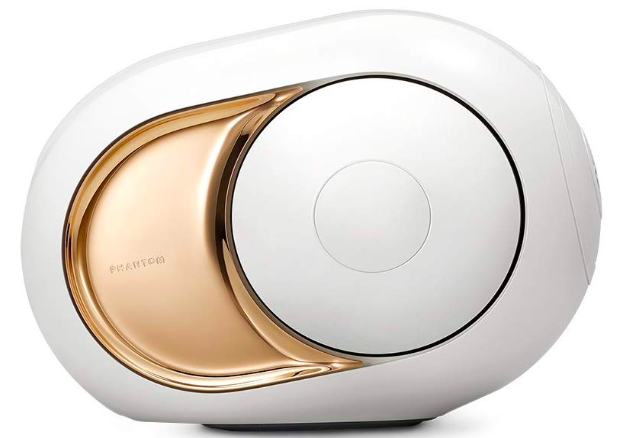
Devialet Gold Phantom. The best wireless speaker in the world. This speaker from Devialet emits an ultra-dense sound with physical impact. No distortion, no saturation, no background noise and features our exclusive Analog Digital Hybrid Technology. With power, clarity, and precision unlike anything, you’ve heard before. With power, clarity, and precision unlike anything, you’ve heard before.
This summer, OMEGA partnered with The Metropolitan Museum of Art to celebrate the 50th Anniversary of the Moon landing, and created the Speedmaster “First OMEGA in Space The Met Edition. This watch comes with a red and white striped NATO strap, a nod to the Museum’s signature color, with The Met’s logo engraved on the loop. Each model will be delivered inside a unique presentation box, crafted with The Met logo, and retail for $5,200.
Our music-obsessed editor in chief swears by the superior sound, chic design, and cutting-edge technology of these Sennheiser Momentum headphones. They feature intuitive controls, active noise cancellation, and transparent hearing so that you can enjoy your tunes while still being fully present in real life. The leather head strap and cushy earcups deliver superior comfort while looking great on the go.
From industry leader and trusted CBD brand, Charlotte’s Web’sholiday box is offering 30 Days of Calm. The box includes a beautiful set of relaxation and holiday tip cards with positive affirmations, activities, and useful information, and includes CBD oil in mint chocolate and Calm gummies, both made from responsibly farmed USA grown hemp. All Charlotte’s Web products are third party tested and a certificate of analysis is available upon request.
Can’t stay away from your tech? Don’t want to rely on campsites with outlets? MPOWERD’s inflatable solar night is perfect. Charge it during the day, then strap it to your tent at night for a lantern that will charge your phone, your GPS, or anything else you need.
Bugaboo Camper, Four Person Nesting Camp Cookset: When our associate editor goes camping, he needs every inch of space. The four-person Bugaboo Camper comes with two pots (2L and 3L) with strainer lids, frying pan, four large mugs with insulated sleeves and Sip-Through Lids, bowls, and plates for everyone, a pot gripper, and a carry bag that doubles as a sink. And all of that fits inside of the 3L pot for easy transport. Perfect for feasting in the great outdoors.
This beautifully designed reading lamp at Roche Bobois, designed by Carlo Zerbaro, with a base and structure in varnished steel with a matte finish, col. black, oxidized steel screen giving a reflection of multi-colored material (oxidized copper). With adjustable direct or indirect light source. Perfect for any room.
Nimble is making tech products from plant-based bioplastics, recycled aluminum, and fabric made from recycled water bottles. The carbon-neutral portable chargers, wireless stand chargers, phone cases, and cables are all shipped in plastic-free packaging made from scrap paper and non-toxic inks and adhesives, and to encourage tech recycling, each item ships with an envelope to pack up your various cables, plugs, phones, mp3 players, and chargers, and you can go online to print out a free shipping label. The company has recently acquired B-Corporation status, verifying that they meet the highest standards of social and environmental performance, transparency, and accountability.
By Michael Hammer, with photography by Eric Laignel
GROUP M —THE INNOVATIVE and diverse public relations and advertising giant—has moved into 3 World Center, making it the latest in a long line of multi-faceted and cutting-edge businesses that reflect the growth and diversity of the community around it. “It’s a great fit,” says the global media investment management group’s Chief Financial Officer, Mark Sanders. “Downtown is the new media hub. It’s a place of revitalization and rebirth. It’s the best place for us to be.”
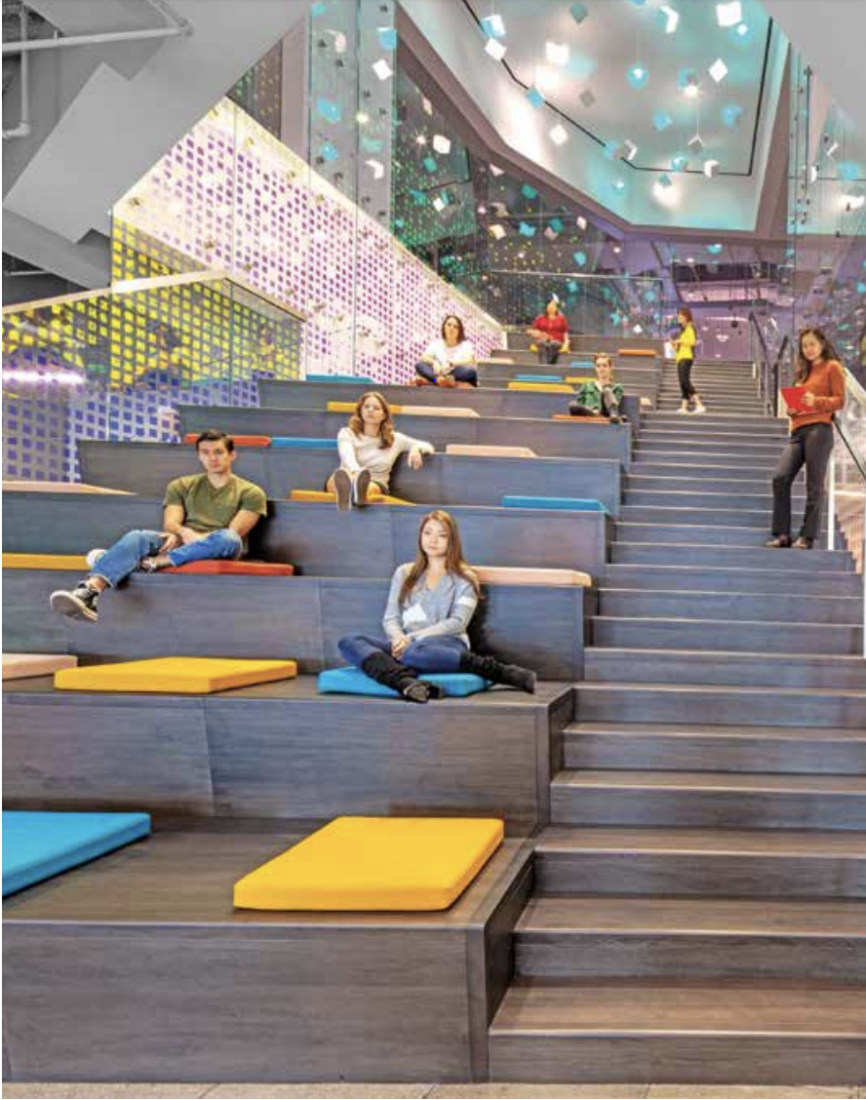
COLLAB: Communal spaces, conference rooms, and workstations allow staff to work together, appreciate the views, or to have a few moments of downtime in a busy day.
The company’s unique new office space houses multiple brands including Essence, Mediacom, and Mindshare in its multi-adaptable 14 floors and 700,000 square feet. The space—which includes a modular town hall theater, a coffee bar complete with baristas, a health care and physical therapy unit, and an open terrace—is home to the company’s over 4,000 employees.
The 80-storey 3 World Trade Center—now the fifth-tallest skyscraper in New York—has been described by Architectural Digest as the “next step in Lower Manhattan’s renaissance.” The building’s “ability to attract hip, creative tenants like GroupM,” according to the magazine, “should accelerate the youth movement already reshaping downtown.” GroupM’s new headquarters is the latest example of cutting edge, collaborative office space for a new demographic.
Sanders says that being an integral part of Silverstein’s vision for a reborn Downtown is an honor. “Downtown is incredibly beautiful and revitalized today. But when we began our search for a new base of operations, it was still in the recovery stage. We took a leap of faith in [developer] Larry Silverstein’s inspiring vision for the area—but we always believed it would become a reality.”
And that goes a long way to explain why the group committed to being 3 World Trade Center’s anchor tenant, occupying about 40 percent of the newest World Trade Center tower. “This is a moment of enormous pride for me and for everyone in the Silverstein organization,” said the renowned developer at the building’s ribbon cutting. “We sought to create modern, environmentally-conscious, and technologically-advanced offices. Places that foster creativity where young people would want to work and collaborate.”
The building’s open environment was originally intended to serve the financial industry, but has been repurposed to provide unparalleled utility and inspiration for one of the most creative media groups in the world. “Many of the same features that are conducive to a trading floor are conducive to the kinds of environments companies are trying to make in general,” observed Jeremy Moss, director of leasing for Silverstein Properties.
And that was one of the main selling points for GroupM. “One of the best things about the space is our ability to be flexible,” Sanders says. “It allows for an enormous amount of creativity. We offer our facilities to all of our clients to utilize—whether it’s one of the many huge conference rooms or the smaller offices. “The unique environment inspires collaboration with our clients and allows talented people to be inventive.”
Sanders describes GroupM’s philosophy as creating an innovative workspace that emphasizes group-wide collaboration while enabling individual agency brands to flourish by taking advantage of the most current trends in agile working. “We needed a lot of space,” Sanders admits. “We have 4,000 people—and that’s not an easy task in itself. But we also wanted to be part of an area that provided for the needs of our employees—and would create a productive, inspiring and fulfilling environment.”
Technology, advertising, media, and information, or TAMI businesses made up 37 percent of the square footage that relocated Downtown in 2016. Media mammoths like Condé Nast and Time Inc. blazed the trail when they moved Downtown. At the end of 2018, TAMI companies made up more than 30 percent of the Downtown office market, up from 17 percent a decade earlier.
And that has helped the company attract, stimulate, nurture, and retain the brightest young talent seeking to work with some of the world’s largest brands. “Having companies like Condé Nast come down here made the decision that much easier,” Sanders says. “People seeking cutting-edge opportunities are flocking here and we want to be there to help them accomplish their goals. The area is a media hub and it made sense for us to contribute to and drive that environment,” Sanders says. “But we also wanted a place where our people would feel connected to the community. We wanted a place that had a real vitality—in business and beyond. We wanted to be among that vanguard to set up shop here and use our voice to drive that dynamic.”
GroupM’s chief executive officer, Kelly Clark, agrees. “Lower Manhattan is quickly becoming a world capital for advertising, media, technology and information. We’re excited about our inspiring new space and everything this neighborhood has to offer.” DT
Held on March 21–24 at Piers 92 & 94, the Architectural Digest Design Show brings together a wide array of established and emerging talent and over 400 luxury brands to discover each year. Now in its 18th year, the event also happens to be one of the only global design trade shows that offers consumers a vantage point into the exclusive world of interiors outside the pages of a magazine or on a TV screen. There is even a section on the show floor that caters to design aficionados’ need for instant gratification—in SHOPS, visitors are welcome to purchase brands’ wares and saunter out of the show with their finds. This week, Downtown readers can enjoy $5 off tickets from Friday, March 22–Sunday, March 24 with code: DOWNTOWNMAG. Below, enjoy a round-up of 10 makers, brands, and one spectacular event that is sure to entice any design enthusiast to the show.
Ngala Trading Co. is a luxury lighting and home decor brand known for offering unique and exotic handmade designs featuring sustainably sourced materials from across Africa. Each piece in the line, founded by Nick Geimer and Lawson Ricketts in 2016, marries European and African design styles in a mesmerizing manner. With designs utilizing feathers, porcupine quills, and leather fashioned into one chic chandelier (see above), there is so much to explore.
The Black Arts furniture and sculpture collection by Nicholas Hamilton Holmes is one very good reason to attend the show. The new collection showcases a variety of ‘tubular’ designs the artisan has manipulated and shaped into distinctive forms. Each piece, from lounge chairs, to book ends, to a cactus-like coat rack, is then dyed all black, allowing only the form’s true nature to stand out. To add a bit of levity, comfort, and depth, the designer adds Brazilian Soapstone, black Danish cord, Mongolian wool, and brass accents to some of his designs.
Founded by its namesake ceramist, New York-based ceramics and lighting studio John Sheppard will showcase eye-catching pieces inspired by Brutalist architecture and building materials. The asymmetrical base of the Conduit Incline Table Lamp (right) is handcrafted from slabs of sand-colored stoneware. A brass hardware piece traverses through it, yielding one unique, illuminating design
Canadian painter Janna Watson is known for her vibrant, abstract works of art. At this year’s AD Design Show, the artist is showcasing her deft hand at creating gorgeous, hand-tufted contemporary rugs. Inspired by her artful compositions, Watson is no longer solely satisfied by defining interiors’ walls but is now applying her talents to creating art underfoot as well.
Founded by Virginia Sin, SIN is chock-full of hand-built, handcrafted, and woven American-made home goods and objets d’art. With tabletops, pillows, furniture, and lighting – including a porcelain ice cream cone light that doubles as a vase – the one-of-a-kind offerings exhibited at SIN are worth the trek in themselves.
Nieve handwoven wool through and Puna handwoven pillow from Sien + Co.
Alexandra Gibson founded Sien + Co. in 2016 after touring Nepal with her daughter. When a lost luggage issue turned into a serendipitous encounter with a cooperative of Nepali artists in Kathmandu, Gibson returned to the US completely inspired. She left her job and began working towards creating handmade textiles with a modern touch. Today, Sien + Co.’s luxurious, handmade knit apparel and home furnishings are sustainably and ethically made. The furnishings are manufactured in collaboration with Identidad Argentina, a company that helps preserve traditional weaving and dying techniques.
If you weren’t particularly into tile before attending the show, Artistic Tile’s Billie Holiday-inspired, Billie Ombre might change your ideas of exactly how artful tile can be. The wave of vibrant colored glass was designed to not only create an overall ombre effect, but to mimic the legendary jazz musician’s trademark melodic expressions. Thematic variations in color are available.
Founded in 2011 by designer Gary Lee, Chai Ming Studios prides itself on impeccable craftsmanship, materiality, and artistry. With bespoke furniture pieces handcrafted to embrace texture, unique finishes, and the unexpected, each piece presents a unique point of view. At this company, it’s all about the collaborative process. Design solutions are aplenty at Chai Ming Studios.
True Residential’s 24″ Dual Zone Undercounter Wine Cabinets. Shown in antique white and gold (left) and matte black and copper.
A luxury home refrigeration brand, True Residential makes one of the most sought-after indoor/outdoor undercounter Dual Zone Wine Cabinets. At 24” in height, the cabinet not only accommodates a total of 45 bottles, but features two independent zones that can be adjusted from 40°F to 65°F and patented TruLumina LED lighting that illuminates your wines in a choice of 14 different ambient color options with the push of a button. Also, the units are now available in custom colors and finishes—perfect to design your bar around.
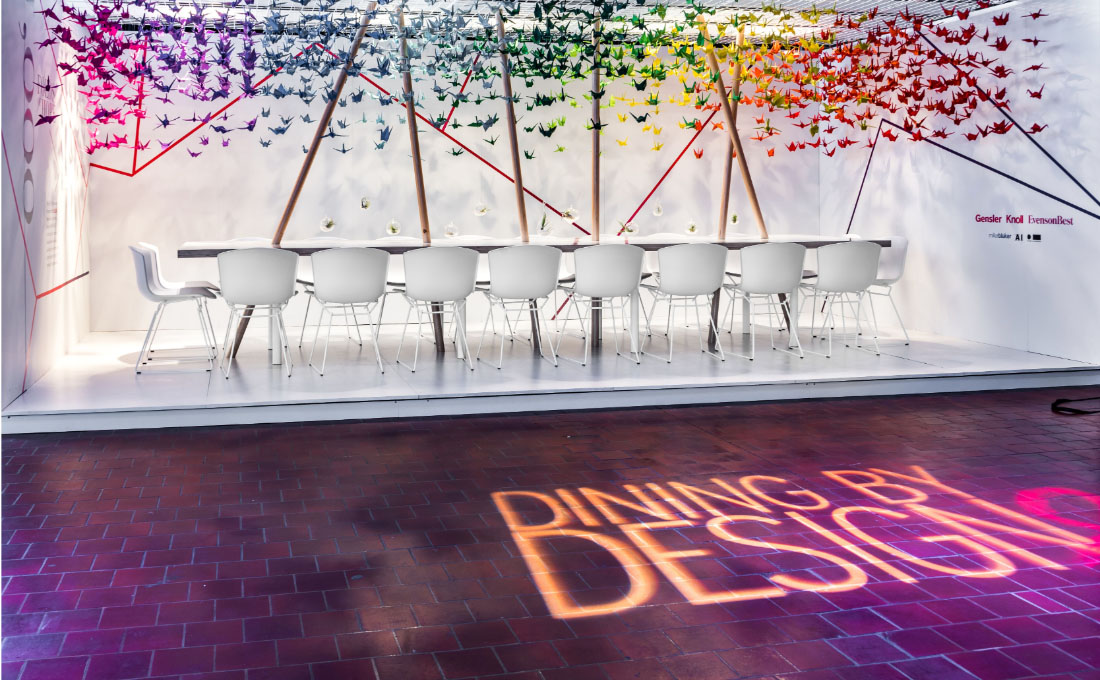
Gensler + Knoll, Dining by Design 2018; Photograph by Alan Barry.
Held in the neighboring Pier 92, an additional perk to attending the show is access to DIFFA’s Dining by Design. The venue is brilliantly transformed each year by some of the country’s top designers into an enthralling display of imaginative dining environments. Often frequented by design devotees and luminaries in the fields of art, fashion, and design, this immersive exhibit is pure creative and functional eye-candy. This year, visitors to the venue will be able to explore collaborative installations between powerhouse designers and brands, including one by Benjamin Moore and Cosentino designed by Tyler Wisler, and another from the New York Design Center designed by Marks & Frantz.
Robert Sonneman, the Executive Chairman and Chief Creative Officer at SONNEMAN—A Way of Light, gives us the lowdown on all things lighting, Sonneman’s new projects, and what drives him today. From a showroom set to open in the spring of this year, to new and much-loved collections, lighting trends, and how technology is affecting the lighting of the future, we discuss it all.
Robert Sonneman.
Downtown: We heard a rumor you were opening up your first NYC Showroom at the New York Design Center. If this is true, please tell us when you expect to open and what made you decide to finally have your own space for designers to visit?
Robert Sonneman: What you have heard is true. Located at the New York Design Center at 200 Lex, we are excited to be opening this spring. The New York City showroom underscores SONNEMAN-A Way of Light’s vision for growth, increased visibility, and focus within the architectural and design community. The Design Center’s location is at the increasingly important epicenter of the design community, making it a clear choice.
Intervals System.
Besides being a natural fit for us, after considering other city locations we recognized the value of being part of a design industry collective. The Design Center draws the attention of the design community to its powerful presence, and we wanted to be a part of that energy.
Downtown: What can visitors to your showroom expect to see?
Robert: SONNEMAN—A Way of Light has developed its broad range of capabilities and scope over decades of design and discovery. This showroom will present product design and innovation to the architecture and design community in a collaborative setting. We will present our product range—showcasing everything from fixtures to our scalable architectural systems—in a gallery-like setting. In addition we will have dedicated spaces for client project layouts and specifications. We will also be committing resources to advance product knowledge and to help communicate project-specific information with design professionals. The space will feature a hands-on “Suspenders Lab” where designers will be able to arrange custom configurations with the assistance of SONNEMAN team members. The showroom will also feature a regular rotation of CEU and ASID events as well as activations throughout the year. We aim to become a resource to the design community in regards to lighting, technology, and design knowledge.
Koi Pond Installation showcasing Suspenders.
Downtown: Tell us about your 2019 collection! When does it launch and what is currently new at Sonneman?
Robert: We have added over 350 new components to the award-winning Suspenders LED system, including 6’ and 8’ power bars, flush-mount solutions for low ceilings, and a new structural element that will allow stacked configurations to run on a dual circuit. We have also introduced nearly infinite options for the newly introduced Intervals System, expanding the initial launch to better serve commercial settings and hospitality spaces. Beyond the impressive number of introductions for our varied scalable systems, we have released a number of new decorative architectural families. These include a new Constellation titled ‘Aquarius’, the expansive Ballet fixture system of multiple poised tapered silhouettes, and the expandable OLA range of flowing linear elements whose soft profiles flow dramatically across a space.
Intervals.
Downtown: What are some of your favorite designs from the new collections and why?
Robert: Despite my tendency to look critically at previously completed designs in my search for how can we do it better, there are some designs that stand up to my scrutiny. The Truss system is one such design that expands the utility and architectural context of the growing Suspenders system. The Intervals beam system holds both the achievement of an architecturally scalable lighting system with multiple applications and the challenge to expand the utility, technology, and applications even further. OLA will open new paths for us to explore a softer approach to form development and an increased potential for new lighting utility.
Downtown: What do you think is the future of lighting?
OLA.
Robert: Technology is driving lighting development and providing opportunities to reimagine its form and application. We are advantaged by the promise of commingling art with technology to envision new applications and utilities. Certainly miniaturization, color, optics, and controllability are the drivers of this fast evolving and exciting activity of science and the art of design. Lighting is a universal and essential element in any space, defining visibility and the emotional response to an environment. What is so exciting about the future is the integration of lighting technologies into the architecture and as a dynamic component of the building systems. This synthesis of electronically generated illumination within the built world will be essential to our perception and interaction within a space.
The lighting of the future will be defined by connectivity, integration, and controllability as a component of the digital age and of a broader environmental system. It is a critical component that can be adjusted to impact the emotional status of our wellbeing.
Downtown: Do you have an all-time favorite Sonneman design? Which is it and why?
Ola.
Robert: My favorite design is…the next one. Design, like life, is a continuum—an odyssey, a journey of discovery. When I look at the designs along the path of my over half-a-century career, I see them in context to where I was at that point in time and whether or not it stands up to the core values of my design principals: functionality from simplicity. Design is evolutionary and only rarely revolutionary, so all of the designs must be measured in the context of the time of their development. Some I see and feel that we conceived a well-executed resolution to challenge and other times I wonder how I could have done that, that I should have done it better or not at all.
That said, if I were tasked with selecting just one, Orbiter most accurately reflects my design process. I designed the Orbiter when I was 23, which was shown briefly at the Museum of Modern Art in 1968. The Orbiter celebrated its 50th anniversary in 2017 and was recently launched in brass by RH Modern. Its purpose was to have a functional light that moved anywhere in a hemisphere—up or down, or fully extended. Somehow there was something that made perfect sense to me, and an integrity in doing something as simply as possible—to execute a task or a function without adornment and to achieve aesthetic value in its functionality and simplicity. There have been many others since, including the scalable systems that have chartered our business forward, but that first piece came to define the origins of my point of view. It was obviously rooted in the Bauhaus idea of form from function.
Orbiter.
Technology in the form of LED, electronically generated illumination, changed everything. It allowed us to reimagine form, scale, application, and utility. For me it was a rebirth of creative energy that drove the promise of innovation. I love working with technology but mostly the opportunity to work with the smart people that technology attracts. My work is a daily and continuous process of investigation for myself and the talented engineering and design team that we are building.
Downtown: What
would you like designers to know about your brand?
Robert: SONNEMAN—A Way of Light is committed to Innovation From The Art of Technology. We are a design-driven company, rooted in our principals of design innovation, high quality, originality, and functional simplicity. We will continue to strive with passion for design innovation and a view toward what’s next.
Downtown: Who is a designer you would love to work with and why?
Robert: I cannot limit the desire to work with a designer to only one. Frank Gehry, Tadao Ando, Mies Van der Rohe. For me, architecture is the root and the basis of my design thought. There are so many giants of architectural design thinking, and I could happily live engaged in the argument, challenges, and the defense of an architectural design vision that makes, “Architecture the battleground of the soul.”
Suspenders Installation.
Downtown: In
your five decades designing lighting, what has been your favorite experience to
date?
Robert: My life has been so blessed with the challenges, struggles, efforts, and rewards of a life in design. Although best known for lighting, I have worked in other disciplines as well. I controlled my destiny and rose and fell at my own hand. Having the opportunity to travel the world at on a regular basis, working, searching, questioning, discovering, and learning, I don’t know if I could choose a favorite because I have been rewarded by so many. I do know that discovery and finding the answer in the creative process continues to give me a high and a sense of accomplishment that never diminishes and continues to drive me forward. My favorite experience is achieving that accomplishment collaboratively. I guess at the end of the day it’s all about people, and I know that my favorite experience is definitely the next one.